
By Nora Keller, PhD
When polished prose can be generated in seconds, what does it mean to remain the author of your own work? And what, exactly, should students be protecting when they use AI to help them write? And how might these developments affect the process of writing your personal statement?

A page from the author’s own notepad
AI writes remarkably competent essays. For students, that’s exactly the problem.
The other day, I asked ChatGPT to come up with a sample paragraph of text to describe the process of academic tutoring (yes: I do use AI in my writing, but very strategically, as detailed below). As I read the output, the writing felt hauntingly familiar, and here’s why: It follows the same conventions many students were taught in high school (think: The classic five-paragraph essay).
Symmetrical.
Carefully signposted.
Slightly detached.
Fond of the rule of threes.
Neatly and seemingly logically concluded.
Full of transitions like "however" and "moreover."
Sometimes overflowing with em dashes and semicolons.
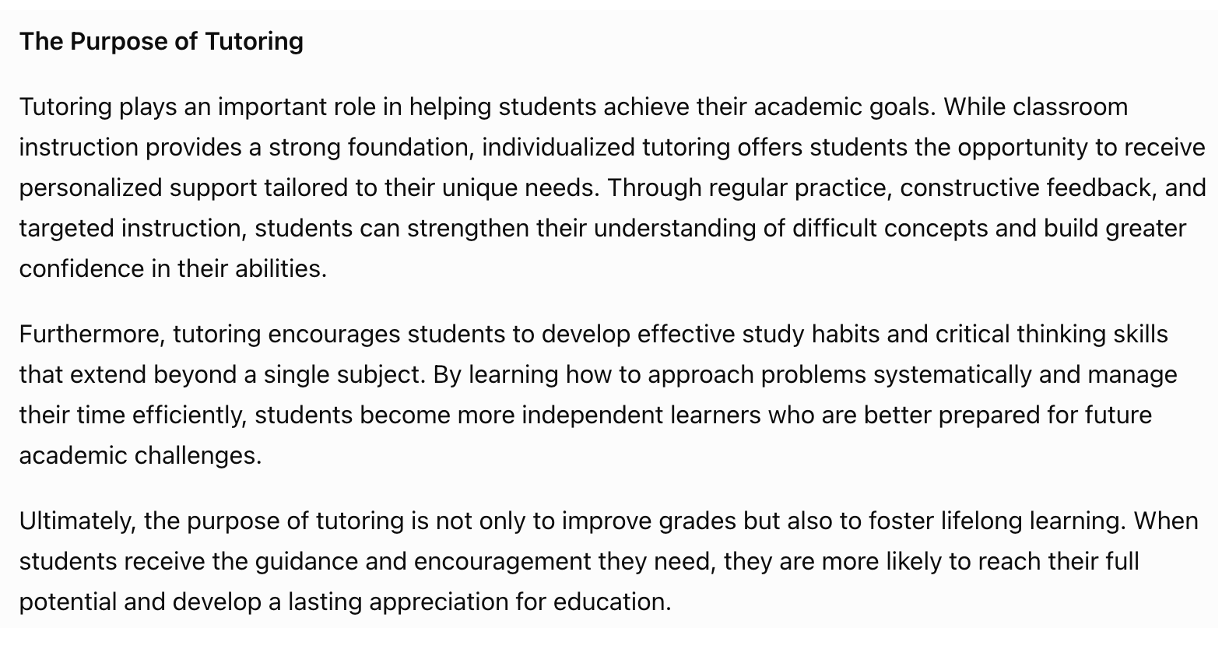
“The Purpose of Tutoring,” as generated by ChatGPT
AI didn’t invent these formulaic writing habits; it inherited them. One of the great ironies of generative AI is that it has exposed something about the way we've taught writing for decades.
But if AI is good at formula, students won’t be able to beat ChatGPT at its own game. What, then, becomes valuable in student writing? I would argue that the answer can be summed up in a single word: Voice. The single word hides a lot of complexity: Voice is about demonstrating judgment, utilizing nuance and specificity, engaging in critical reflection, and a student’s unique point of view and personal experience. It’s the inexplicable secret ingredient that makes a piece of writing unequivocally yours.
We've shifted what counts as a signal of strong writing. Twenty years ago, clean grammar itself was impressive. Today, grammar is increasingly a baseline. Consequently, admissions readers look elsewhere.
They ask:
Does this student have an interesting perspective?
Can they make a nuanced argument?
Do they notice something unexpected?
Do they reflect rather than merely describe?
What am I learning about the author as a person?
In other words: Can this student think for themselves?
As AI raises the floor of writing quality, the ceiling changes.
My hunch is that us educators and readers will increasingly value evidence of thinking that happens in real time. In a school or university context, that might be an in-class handwritten essay or thoughtful contributions to classroom discussions. In a college application, the interview could well gain in importance. The currently optional essay portion of standardized tests like the ACT or SAT may become weightier.
Above all, the personal essay will remain essential in its revelatory power about what makes the student who they are: how someone makes meaning, what drives them, what they care about.
Does this mean students shouldn’t use AI in their writing generally, or specifically in their college essay? Of course not. For one, working with AI has already become an indispensable skill, and students need to master it.
The question is HOW to collaborate with AI without taking a backseat in the writing process. Students need to learn to collaborate with AI while remaining the authors of their own pieces of writing. AI can serve as an editor who points out errors and provides critical feedback, but it cannot (or rather, should not) do your writing for you. In this way, AI makes an important contribution to increasing accessibility and equity for less privileged students. While students from higher socio-economic backgrounds often get editorial guidance from parents, counselors, or friends, less privileged students lack this sort of access, and it shows in their writing. AI can level the playing field.
The goal is not to produce writing that sounds less like AI. The goal is to produce writing that sounds unmistakably like you.
How to use AI without losing your voice
Start before AI. Know what you think before asking for feedback.
Ask for critique, not replacement. Treat AI like an editor, not a ghostwriter. Assign it a clearly bounded role.
Finish alone. Read the final version without AI. Does it still sound like you?
Protect your style. Don't let AI smooth away the quirks that make your writing recognizably yours.
AI changes the writing game for students, but in some ways, the aims of the game are staying very much the same: The purpose of writing has never been to produce perfect sentences. It has always been to express thought.
Writing something of your own? I work one-to-one with students on college essays, academic research, and writing.
